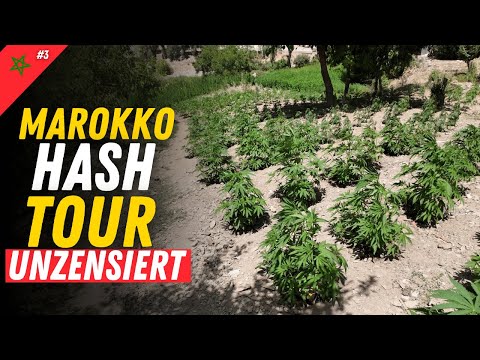
In the Rif Mountains of northern Morocco, cannabis has been cultivated for centuries. The documentary footage from this farm in the Ketama region reveals the reality behind a product consumed across Europe daily: traditional hashish production as practised by families who have refined these techniques across generations. What you see here is not industrial; it is intimate, skilled, and shaped by altitude, climate, and heritage.
Ketama — Heart of Moroccan Cannabis
Ketama is a name that carries weight in cannabis culture. The small town sits at roughly 1,600 metres above sea level in the central Rif Mountains, surrounded by steep valleys where cannabis fields stretch across terraced hillsides. Morocco produces more hashish than any other country in the world – UNODC estimates consistently place Moroccan cannabis cultivation among the highest globally – and Ketama is the epicentre of that production.
The Rif is not a monoculture cannabis zone by choice alone; it is partly geography. The combination of altitude, Mediterranean climate, and specific soil composition creates conditions that produce cannabis plants with resin gland densities that are difficult to replicate elsewhere. Farmers in the region call this combination the baraka – the blessing – of the land.
Geographic Context: Rif Mountains, Northern Morocco
The Rif range runs roughly east–west across northern Morocco, separating the Mediterranean coastal strip from the interior plateau. Cannabis cultivation is concentrated in a corridor stretching from Ketama westward to Chefchaouen and eastward toward Al Hoceïma. This region, historically isolated and economically marginalised, developed cannabis cultivation as its primary cash crop over centuries of interaction with Berber agricultural traditions.
The altitude matters. At 1,400–2,000 metres, plants experience strong UV radiation that stimulates resin production as a natural defence mechanism. Cool nights contrast with warm days, extending the flowering period and developing terpene complexity. The soil in the Ketama region is predominantly clay-loam, mineral-rich, and well-drained due to the mountain terrain. The plants grown here are, by modern standards, essentially organic landrace varieties.
Traditional Hash Production
The production of Moroccan hash – known locally as kif in its raw form and chira as pressed product – follows methods documented across several centuries of North African cannabis history. The documentary footage from this Ketama farm shows the process in its traditional form, largely unchanged from techniques practised by the farmer's grandparents. The transformation from plant to pressed hash involves three fundamental stages: harvest, sieving, and pressing.
The Dry-Sift Process
Dry-sifting is the foundation of Moroccan hash production. After harvest, dried and cured plant material is placed on a fine mesh screen. The traditional Moroccan method uses a circular sieve (locally called a taârifet) stretched with woven fabric, now often supplemented by precision-mesh industrial screens for higher-volume production.
The plant material is beaten against the screen. Trichome heads – the resin glands containing THC, CBD, terpenes, and other cannabinoids – break off from the plant material and fall through the mesh onto a clean surface below. What passes through the screen is the raw sift: a fine, golden-blonde powder of loose trichomes.
Quality at this stage depends on multiple variables: mesh size (finer mesh = purer product but lower yield), plant dryness, and technique. The first pass through a fine mesh produces the highest quality sift; subsequent passes through coarser mesh produce larger quantities of lower quality material.
Pressing Methods
Raw sift in powder form is not stable for transport or storage. Pressing – applying heat and pressure to the loose sift – transforms it into the dense, pliable blocks that characterise Moroccan hashish. Traditional pressing in Ketama uses wooden or metal presses, sometimes simply the hands wrapped in wet cloth, with gentle heat applied to activate the resins and bind the powder into a cohesive mass.
The temperature, pressure, and duration of the pressing process affect both the physical characteristics and the chemical profile of the final product. Higher heat produces darker, more malleable hash with a more pronounced toasted aroma; lower temperature pressing preserves more volatile terpenes and produces a lighter, more aromatic product.
Strains & Genetics: Moroccan Beldia and Kif Varieties
The genetic base of Moroccan cannabis is the Beldia – the local landrace. Over centuries of cultivation in the Rif, the Beldia has adapted to the specific conditions of the region. It is a sativa-dominant variety, tall and loosely structured, with a flowering period tuned to the long Moroccan summer. Modern cannabis genetics have begun to enter the Ketama region over the past two decades, but traditional farms in the higher elevations still cultivate Beldia as the primary variety.
The kif grown from Beldia plants has a characteristic aromatic profile: earthy and herbal on the base, with floral and slight citrus notes in the upper register. Terpene analysis of traditional Moroccan hash typically shows myrcene, caryophyllene, and pinene as dominant terpenes – distinct from Afghan hash and from Lebanese hashish.
Daily Life of a Hash Farmer
The documentary's value lies in what it shows beyond the production process: the texture of daily life in a Ketama farming community. The farm is a family operation, as almost all Ketama cannabis cultivation is. Multiple generations are involved across the year, with the heaviest labour concentrated in the late summer harvest period and the autumn sieving and pressing season.
Harvest Season
Harvest typically begins in September when the Beldia plants reach full maturity and the trichomes are at peak density. The harvest window is narrow – a matter of weeks – and the entire family mobilises for it. Cutting, drying, and initial processing happen rapidly to prevent moisture-related quality loss.
Economics
The economic reality of Ketama farming is documented in EMCDDA Morocco cannabis profile reports and academic studies. Cannabis cultivation provides income where alternative crops cannot. The terrain precludes mechanised agriculture; markets for other crops require transportation infrastructure that is limited in the Rif's interior. Farm-gate prices in Ketama are a fraction of European retail prices. The margin is captured by distribution networks that operate beyond the farmer's visibility.
Morocco vs. Other Hash Origins
Moroccan hashish is Europe's most consumed hash variety, but it exists within a broader global hash culture that includes Afghanistan, Lebanon, India, and beyond.
Hash Origins Compared: Morocco, Afghanistan & Lebanon
| Origin | Production Method | Texture | Potency | Dominant Character |
|---|---|---|---|---|
| Morocco (Ketama) | Dry-sift (mechanical sieving), hand-pressed | Soft, pliable, crumbles cleanly | Moderate–High (10–25% THC) | Earthy, spiced, hashish-classic |
| Afghanistan | Dry-sift or hand-rubbed (charas-adjacent) | Dense, dark, very hard; softens with heat | High–Very High (15–35% THC) | Fuel, rubber, deep resin |
| Lebanon | Dry-sift, pressed with heat | Brittle, golden-brown, distinct snap | Moderate (8–18% THC) | Floral, sweet, lighter than Afghan |
Each origin's hash reflects not just production technique but geographic and cultural context. For further academic documentation on global hash production and the Moroccan cannabis economy, the EMCDDA Morocco Cannabis Report provides the most comprehensive publicly available research. Leafly's hash guide offers accessible consumer-level context.