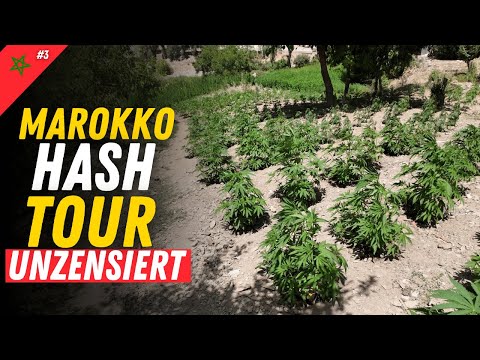
Morocco Second Farm Ketama: Strain Quality Comparison. The second farm visited in this documentary series sits three kilometres from the first, at a slightly higher elevation, and produces hashish that is immediately, unmistakably different in character. This comparative dimension – the way that small variations in altitude, microclimate, genetics, and farmer technique produce distinct products – is what makes the Ketama region such a compelling subject for anyone serious about understanding hash culture.
Ketama — Heart of Moroccan Cannabis
The Rif Mountains' cannabis cultivation zone is not homogeneous. Within the area informally known as the Ketama region, there is significant variation in growing conditions. This second farm demonstrates that variation in concrete, observable terms: same regional genetics, same production tradition, different microclimate and farmer selection practices, different product character.
Cannabis cultivation in the Rif has always been characterised by this kind of localised variation. Farmers do not simply grow a commodity crop; they manage a living system whose outputs are sensitive to dozens of variables. The documentary's decision to visit a second farm and draw comparisons makes explicit what experienced Ketama hash consumers have known intuitively: that where in the Rif and who grew it matters as much as the fact that it came from Morocco.
Geographic Context: Altitude, Aspect, and Microclimate
This second farm operates at approximately 1,750 metres above sea level – roughly 150 metres higher than the first farm. That difference matters. At higher elevation in the Rif, UV radiation intensity increases, accelerating resin production. Night temperatures drop further, extending the temperature differential between day and night that promotes terpene development in the maturing flowers.
The farm's slope faces southeast rather than the more common south-facing orientation of the first farm. Southeast aspect means earlier morning sun and slightly reduced afternoon heat – a combination that some farmers in the region claim produces more aromatic hash at the cost of slightly lower yield per plant. The documentary's tasting comparison supports the claim that the second farm's product is notably more aromatic.
Traditional Hash Production at the Second Farm
The production methods at this second farm follow the same fundamental steps as the first – dry-sift, pressing, packaging – but with differences in equipment and technique that reflect the individual farmer's approach. Where the first farm uses contemporary precision-mesh screens, the second farm's elderly farmer works almost exclusively with inherited equipment: a set of sieving screens whose mesh he estimates at 70–80 years old, repaired multiple times but never replaced.
His explanation is practical and philosophical: the old screens have a mesh that he knows, that he has calibrated his technique to, and that produces a specific grade of sift that his regular buyers expect. Switching to modern screens would require re-learning the relationship between technique and output – a disruption he regards as unnecessary.
The Dry-Sift Process: Differences from Farm One
The most observable difference is the approach to multiple passes. The first farm uses three successive passes through screens of decreasing mesh size, recovering material at each stage for separate grades. The second farm's farmer uses a single-pass approach: one sieving session per batch, producing a single grade of sift that he argues is more consistent than the graded output of multi-pass methods.
The resulting sift from this farm is slightly coarser in texture – more trichome heads of varying size together. This produces a pressed hash that is less refined in appearance but, as the film's sensory assessment sequence demonstrates, highly complex in aroma. The coarser grade retains more terpene-rich trichome material that finer sifting would remove.
Pressing Methods: Traditional vs. Modern
This farm uses the most traditional pressing method shown across both documentary episodes: no press equipment, only hands, breath, and cloth. The farmer takes a portion of sift wrapped in cellophane, warms it briefly near the wood stove, then presses it with his palms in a rolling motion that compacts and shapes the block simultaneously. The result is a hand-pressed block with finger-mark texture on the surface – what European hash consumers have historically called "finger hash" or hachís de mano.
The farmer argues that lower temperature pressing preserves the volatile terpenes that give the hash its aroma character. Hand-pressed hash is typically more pliable and more immediately aromatic than press-assisted product.
Strains & Genetics: Comparative Analysis
The strain comparison that forms the documentary's title focus takes place in the final sequence, where both farms' representatives are present with samples of their respective products. The comparison is visual, tactile, and olfactory – the kind of sensory assessment that defines traditional hash culture.
The genetic base at both farms is Beldia, but the phenotypic divergence is significant. The second farm's plants are taller and more loosely structured – classic sativa phenotype – with longer internodal spacing and less dense flower clusters than the first farm's more compact plants. This reflects generations of selection pressure in opposite directions: the first farmer has selected for density; the second farmer has selected for resin quality and aroma.
Strain Comparison: First Farm vs. Second Farm
| Characteristic | First Farm (Farm A) | Second Farm (Farm B) |
|---|---|---|
| Plant structure | Compact, moderate height | Tall, loose sativa structure |
| Elevation | ~1,600m | ~1,750m |
| Sieving method | Multi-pass, graded screens | Single-pass, traditional mesh |
| Hash texture | Uniform, dense, commercial-grade | Pliable, slightly variable, aromatic |
| Aroma profile | Earthy, herbal, classic Ketama | Floral, complex, pronounced terpene character |
| THC estimate | Moderate-high (12–20%) | Moderate (10–18%) |
| Best suited for | Consistent daily use; reliable character | Connoisseur consumption; aromatic appreciation |
Daily Life of a Hash Farmer — Second Farm Perspective
The elderly farmer at the second farm has cultivated this land for over fifty years. He represents a generation for whom the transition from traditional to modern practices has been gradual and selective: some changes accepted (synthetic fertiliser in occasional deficit years, contact with outside buyers via mobile phone), many changes declined (new genetics, machine-assisted pressing, scaled production). His approach is a conscious preservation of a method that he regards as producing superior product.
Harvest Season at Higher Elevation
Harvest at 1,750 metres occurs two to three weeks later than at the lower elevation farms. The extended growing season produces flowers with deeper resin development, but it also compresses the harvest-drying-sieving timeline before winter weather makes outdoor work difficult. The farmer's calculation of when to cut – balancing maximum resin development against weather risk – is the most consequential judgment call of the agricultural year.
Economics and the Generational Question
The second farm's economic situation illustrates a dynamic common across the Ketama region: the current farmer has no successor. His children have moved to Casablanca and Nador; his grandchildren know the farm but have no intention of taking it over. What happens to this farm, this seed stock, and this accumulated technique knowledge when the current farmer can no longer work is an open question. This generational transition challenge is documented in academic literature on Moroccan cannabis agriculture as one of the structural factors likely to accelerate modernisation of production methods in the coming decade.
Morocco vs. Other Hash Origins
The diversity demonstrated across just two Ketama farms suggests the complexity of trying to characterise "Moroccan hash" as a uniform category.
Hash Origins Compared: Morocco, Afghanistan & Lebanon
| Origin | Production Method | Texture | Potency | Dominant Character |
|---|---|---|---|---|
| Morocco (Ketama) | Dry-sift (mechanical sieving), hand-pressed | Soft, pliable, crumbles cleanly | Moderate–High (10–25% THC) | Earthy, spiced, hashish-classic |
| Afghanistan | Dry-sift or hand-rubbed (charas-adjacent) | Dense, dark, very hard; softens with heat | High–Very High (15–35% THC) | Fuel, rubber, deep resin |
| Lebanon | Dry-sift, pressed with heat | Brittle, golden-brown, distinct snap | Moderate (8–18% THC) | Floral, sweet, lighter than Afghan |
What distinguishes Moroccan hash as a category from Afghan or Lebanese is not just geography but the specific combination of Beldia genetics, Rif Mountain conditions, and dry-sift production tradition. The comparison between Farm A and Farm B in this documentary shows that even within Morocco, even within the same valley system, the category is not monolithic. Provenance within Morocco matters as much as provenance within Afghanistan does among Afghan hash consumers.
For further research, the EMCDDA Morocco Cannabis Report provides the most current academic documentation. Leafly's hashish explainer covers consumer-level hash culture context comprehensively.